

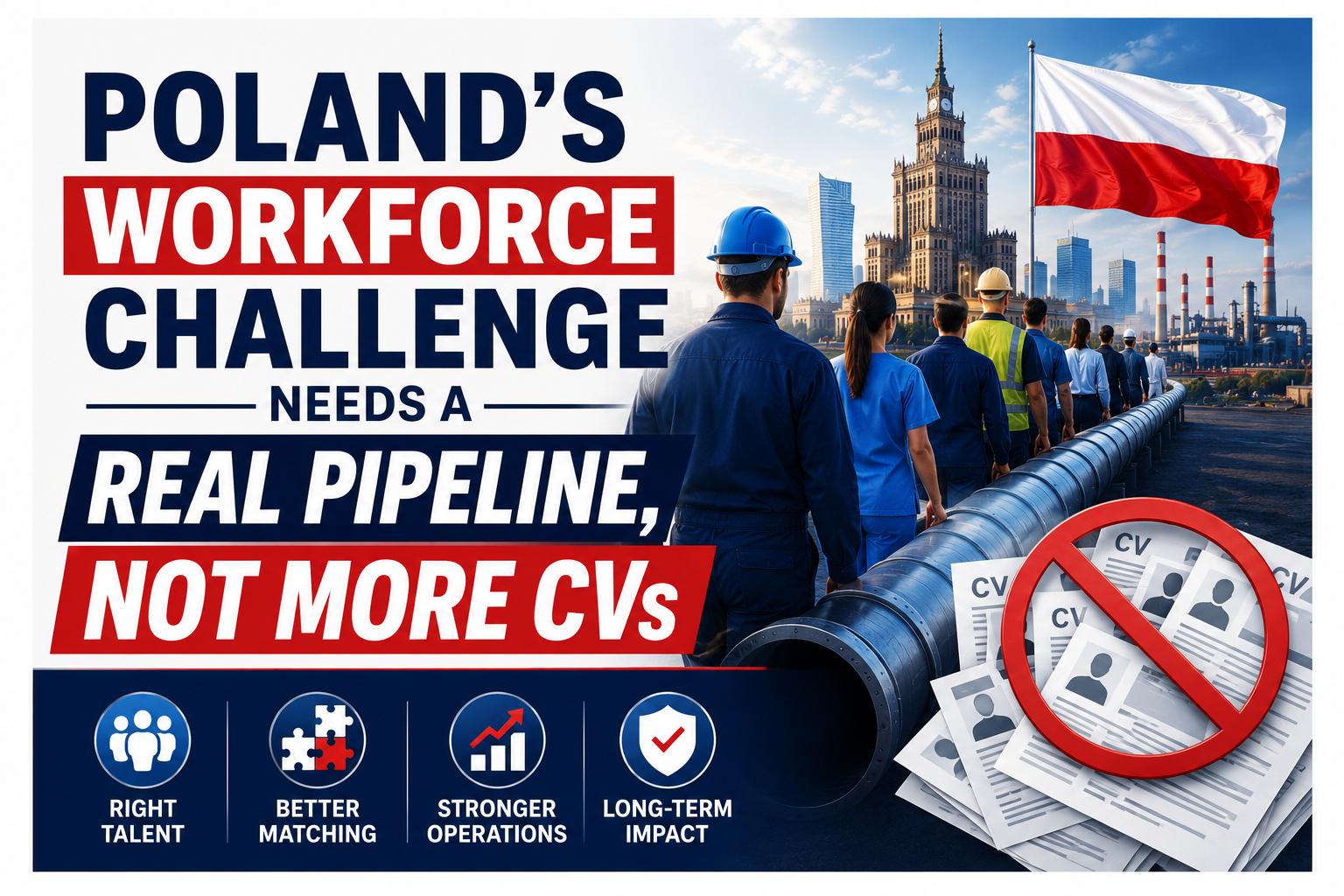
Polish warehouses, factories, logistics operations, and service businesses are under pressure. Labour shortages are no longer a future concern—they are affecting daily output, shift coverage, delivery commitments, and growth plans today.
When positions stay open, the impact is immediate. Warehouse capacity drops. Production schedules slow down. Existing teams carry extra pressure. Employers may even turn down new contracts because they cannot guarantee the workforce needed to deliver them.
The answer is not another database of unverified CVs
The answer is a reliable, compliant workforce pipeline.
At Global Talent, we help Polish staffing agencies and employers access trained Indian candidates who are prepared for overseas work. We are not simply a recruiter sending names into a process. We are a workforce development engine built around preparation, documentation, screening, and long-term workforce readiness.
Our candidates come from an active pipeline across India. Before an employer sees a profile, candidates are assessed against the actual role requirement: physical demands, shift patterns, language expectations, equipment experience, and the work environment. This matters because a warehouse role, a production-line role, and a logistics position all require different levels of readiness.
A candidate who is not prepared creates delays. A candidate who is properly screened creates confidence.
That is why our process goes beyond basic sourcing. Candidates are checked for overseas-work willingness, physical fitness, documentation readiness, medical fitness, police verification, and relevant role suitability. Their profiles are prepared in a clear European format, so employers know what the candidate can actually do—not simply what sounds impressive on paper.
For Polish employers, this reduces the administrative burden and lowers the risk of poor matching. Instead of spending valuable time filtering incomplete applications, they receive employer-ready candidates aligned to the job specification.
AI can support this process, but it cannot replace the need for people.
AI can help employers forecast workforce demand, identify repeated staffing gaps, organize documents, prepare interview questions, and improve communication across international teams. It can also support workers after deployment through training materials, translation assistance, shift planning, and workplace guidance.
But AI does not load trucks, operate production equipment, maintain warehouse flow, care for patients, or build trust inside a team. It boosts the work of employees; it does not remove the need to hire capable, reliable people.
The companies that will succeed in Poland’s changing labour market are those that plan ahead. They will not wait until a shortage becomes a crisis. They will secure a workforce partner with the systems, training infrastructure, compliance knowledge, and candidate pipeline to deliver at scale.
Global Talent helps make that possible: trained candidates, documented correctly, screened thoroughly, and ready to work.